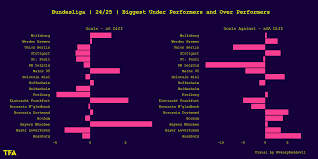

In the 2024/25 Bundesliga, a few teams have scored far more than their chance quality suggests, turning modest expected goals into eye-catching returns. Those gaps between low xG and high goal tallies are classic early warnings that a side may be overperforming in a way that is hard to sustain, especially once variance and finishing form begin to normalise.
Why Low xG with High Goals Signals Potential Overperformance
Expected goals measure how often a typical shot becomes a goal based on historical data, so xG provides a baseline for what an “average” team would be expected to score from its chances. When a side consistently scores well above that expectation, it either contains exceptional finishers, enjoys a run of favourable breaks, or both, raising the probability that its current output is inflated relative to its underlying process. Over time, most teams drift back toward finishing roughly in line with xG, which makes big, persistent positive gaps a logical place to search for looming regression.
What 2024/25 Data Say About Bundesliga Overperformers
Mid-season analyses of the 2024/25 campaign identify several clubs whose goals meaningfully outstrip their xG. One breakdown highlights Bayern Munich’s fast start under Vincent Kompany: they scored 33 times from just 24.24 xG after ten matches—an overperformance of 8.76, the largest attacking surplus in the league at that stage. Eintracht Frankfurt show a similar pattern in later dashboards, averaging 2.30 goals per game from an xG of only 1.50, meaning they add roughly 0.8 goals per match beyond what shot quality alone predicts.
The same data set flags Mainz and Wolfsburg among the few other teams with a goals–xG difference greater than two, while Werder Bremen and Hoffenheim sit in mild positive territory. This cluster of names underscores that overperformance is not confined to title contenders; it can also appear in mid-table sides whose efficient finishing temporarily disguises average underlying creation.
Key 2024/25 Overperformers to Treat Carefully
Not all positive gaps carry the same weight, but the largest ones deserve particularly close attention. Bayern’s early-season numbers show elite finishing converting a strong but not unprecedented xG total into outstanding goal output, while Frankfurt ride a striking per-game surplus built on scoring from fewer and lower-quality opportunities. Mainz and Wolfsburg, meanwhile, sit in a band where their goals exceed xG enough to hint that recent attacking success may be running ahead of what their patterns of play support.
| Team | 2024/25 attack vs xG profile |
| Bayern Munich | 33 goals from 24.24 xG after 10 games, an 8.76-goal surplus, driven by extremely clinical finishing. |
| Eintracht Frankfurt | Around 2.30 goals per game from 1.50 xG per game, +0.8 goals per match over expectation. |
| Mainz | Goals more than two above attacking xG, pointing to efficiency beyond shot quality. |
| Wolfsburg | Goals exceeding xG by nearly three across the sample, suggesting favourable finishing run. |
A table like this frames why “they finish everything” can be a double-edged compliment. When conversion rates sit far above what xG implies, even strong teams risk slipping once their finishing cools or opposing goalkeepers stop conceding at such a high rate, while mid-level sides may see results slide sharply if shot quality doesn’t improve to support their earlier scoring levels.
Mechanisms That Create Low xG but High Goal Returns
There are several paths to overperformance, and only some of them are sustainable. One mechanism is clusters of world-class finishing: strikers who routinely place shots into corners or take early efforts defenders and models are not fully prepared for, which can support a moderate, persistent edge over xG. Another is tactical emphasis on shooting from situations that xG models rate modestly—tight angles, quick shots under pressure—but which specific players have mastered, leading to more goals than the average historical shooter would produce.
Short-term variance also plays a large role. A team can enjoy a run where speculative efforts fly into the top corner, deflections fall kindly and defenders or goalkeepers make unusual errors, all of which inflate goal totals without changing the underlying quality of the attempts. Because xG is built from thousands of previous shots, those streaks stand out as deviations and, statistically, are unlikely to last indefinitely.
Comparing Sustainable Skill to Unsustainable Runs
The challenge is separating genuine, repeatable skill from hot streaks that are likely to fade. Long-term overperformance—multiple seasons of finishing above xG by the same forward or the same core of attackers—can point to special talent, unique tactical patterns or shot types that models undervalue. In contrast, sudden surges where an ordinary squad leaps several goals above xG over a partial season, without a track record of clinical finishing, usually lean more toward variance and are candidates for regression toward the xG line.
How Overperformance Shapes League Position and Future Risk
In the table, xG overperformance acts like a hidden boost. Clubs that consistently score more than expected often sit higher than their underlying process would otherwise justify, banking points that depend heavily on continued clinical finishing or good fortune. That can make them look more dominant than they really are, which matters because if their finishing falls back toward normal, their goal difference and points totals are likely to come under pressure without any visible collapse in chance creation.
For Bayern, overperformance simply adds a layer of dominance to an already powerful attack, so regression might reduce margins of victory rather than dramatically changing results. For Frankfurt, Mainz or Wolfsburg, by contrast, a cooling finishing run could mean dropping from narrow wins into draws, or from draws into losses, especially if defensive metrics are less impressive, turning what looked like a stable surge into a fragile overperformance phase.
Reading Overperforming Attacks From an Odds Perspective
From an odds interpretation standpoint, teams with low xG but high goals become risky to back blindly once markets price in their hot streak. If prices on overs, “team to score” or match outcomes already assume that a club will continue scoring at its recent rate, yet xG suggests that rate is unsustainably high, the implied probabilities can overshoot, leaving little or no long-term value in following the trend. In those settings, the more disciplined move is often to downgrade expectations or even oppose inflated lines, anticipating that goal output will move closer to xG rather than stay at peak conversion levels.
On the other side, underestimating genuine skill can be dangerous. If a side combines consistently strong xG with repeat overperformance by elite forwards—Bayern being a prime example—markets may be correct to sustain higher goal expectations, and fading them purely on the basis of a positive goals–xG gap may amount to betting against established finishing quality. The key is to match the size and persistence of the gap with what is known about the players and tactical context rather than applying a blanket “they must regress” rule.
Using UFABET Lines to Judge When Overperformance Is Fully Priced
In practical terms, timing matters as much as identifying overperformance. Some betting environments adjust rapidly when a club goes on a clinical scoring run, lifting totals and tightening prices on that team’s goal-related markets, while others react more slowly, allowing a brief window where hot finishing is not fully reflected in the odds. When you monitor how markets for Bayern, Frankfurt or Mainz move across successive matchdays on สล็อต ufa168 เวปตรง and see lines steadily rising in response to recent goal flurries even though xG remains modest, that pattern suggests that the overperformance is becoming fully priced in, which reduces the rationale for continuing to follow the trend at current odds.
Where the “Overperformance” Label Can Mislead
Treating every positive goals–xG gap as a bubble waiting to burst oversimplifies what xG can and cannot capture. Models may undervalue specific shot types, such as carefully placed long-range efforts or finishes from unusually skilled attackers, meaning that part of the apparent overperformance reflects under-modelled ability rather than pure luck. In those cases, expecting full regression back to xG underestimates the sustainable edge that certain teams or players can maintain over long periods.
Sample size also matters. Early-season numbers or short runs around international breaks provide too little data to draw strong conclusions, and basing aggressive contrarian positions on small gaps accumulated over a handful of games invites error. The more minutes and shots behind a positive differential, and the more it aligns with or contradicts known finishing quality, the better the basis for any decision about future performance.
How casino online Presentation Shapes Perception of Clinical Teams
Market presentation often amplifies the stories of overperforming attacks. Digital betting menus tend to feature teams on scoring streaks prominently in boosted goal markets, goal-scorer specials and high-line totals, reinforcing the impression that their output is the new normal rather than a potential peak. When browsing a casino online interface during a round where Bayern or Frankfurt appear in multiple highlighted goal props, a more grounded approach is to step back from the promotional framing, compare their recent goal numbers to their xG trends, and decide whether current prices assume a level of clinical finishing that history and underlying data suggest is unlikely to last indefinitely.
Summary
In 2024/25, Bundesliga teams whose goals significantly exceed their xG—most notably Bayern Munich, Eintracht Frankfurt, and to a lesser extent Mainz and Wolfsburg—illustrate how sharp finishing and variance can lift results above what underlying chance quality alone would predict. These positive gaps signal potential overperformance risk because most sides eventually see scoring rates move closer to xG unless they possess rare, repeatable shooting skill that models undervalue. By distinguishing sustainable talent from hot streaks, watching how quickly odds respond, and resisting price levels that already assume continued extreme efficiency, analysts can treat low-xG but clinical teams as situations to be evaluated cautiously rather than trends to follow blindly.