
Introduction
5G technology is the fifth generation of mobile network communication, designed to deliver extremely fast internet speeds, ultra-low latency, and massive connectivity for modern digital applications. It is a significant upgrade over previous generations such as 3G and 4G, and it is expected to transform industries including healthcare, transportation, education, entertainment, and smart cities.
As the world becomes increasingly connected through smartphones, IoT devices, and cloud-based services, the demand for faster and more reliable communication networks continues to grow. 5G technology addresses these needs by enabling real-time communication between billions of devices with minimal delay and high efficiency.
What is 5G Technology?
5G is a wireless communication technology that uses advanced radio frequencies and network architecture to transmit data at extremely high speeds. It is designed to provide download speeds that are significantly faster than 4G, along with improved capacity and reduced latency.
Unlike previous generations, 5G is not just about speed; it is about creating a fully connected ecosystem where machines, devices, and humans can communicate seamlessly in real time. This makes it a foundational technology for emerging innovations such as autonomous vehicles, smart cities, and remote surgeries.
How 5G Technology Works
5G networks operate using a combination of advanced technologies such as millimeter waves, small cell networks, beamforming, and massive MIMO (Multiple Input Multiple Output). These technologies work together to increase data transmission speed and network efficiency.
Millimeter waves allow higher frequency communication, which enables faster data transfer but requires more closely spaced antennas. Small cell networks help distribute signals across dense urban areas, improving coverage and reducing congestion. Beamforming technology directs signals toward specific devices instead of broadcasting in all directions, which improves efficiency and signal strength.
Key Features of 5G Technology
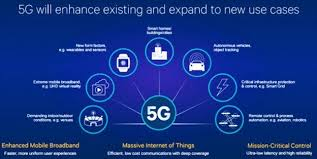
One of the most important features of 5G technology is ultra-low latency, which reduces the delay between sending and receiving data to nearly real time. This is critical for applications such as autonomous driving and remote medical procedures.
Another key feature is high-speed data transfer, which enables users to download large files, stream high-quality videos, and use cloud-based applications without interruption. 5G also supports massive device connectivity, allowing millions of IoT devices to operate simultaneously within a small area.
Applications of 5G Technology
5G technology has a wide range of applications across multiple industries. In healthcare, it enables remote surgeries, real-time patient monitoring, and advanced medical imaging systems. In transportation, it supports autonomous vehicles that require instant communication with surrounding infrastructure and other vehicles.
In education, 5G enables immersive learning experiences using augmented reality (AR) and virtual reality (VR). In entertainment, it allows seamless streaming of ultra-high-definition content and cloud gaming without lag. Smart cities also benefit from 5G through improved traffic management, energy optimization, and public safety systems.
Benefits of 5G Technology
5G technology offers several major benefits, including faster internet speeds, improved network capacity, and enhanced connectivity. It enables real-time communication between devices, which improves efficiency in various applications.
It also supports innovation in emerging technologies such as AI, IoT, and autonomous systems. Additionally, 5G improves user experience by providing stable and reliable connections even in densely populated areas.
Challenges of 5G Technology
Despite its advantages, 5G technology faces several challenges. One major challenge is the high infrastructure cost required to build and maintain small cell networks and advanced communication systems.
Another challenge is limited coverage in rural and remote areas, as 5G networks require dense infrastructure for optimal KQBD. Security concerns also exist, as increased connectivity creates more potential entry points for cyberattacks.
Additionally, some concerns have been raised about energy consumption and the environmental impact of large-scale 5G deployment.
Future of 5G Technology
The future of 5G technology is highly promising, as it is expected to serve as the foundation for future innovations such as smart cities, advanced robotics, and fully autonomous transportation gavang tv. It will also play a key role in the development of the Internet of Things (IoT), enabling billions of connected devices to communicate seamlessly.
In the coming years, 5G will continue to expand globally, improving digital infrastructure and enabling new business models and technologies. It will also pave the way for the development of 6G technology, which is expected to be even faster and more intelligent.
Conclusion
5G technology represents a major leap forward in the evolution of mobile communication. By providing ultra-fast speeds, low latency, and massive connectivity, it is transforming the way people and machines interact.
Although challenges such as infrastructure cost and security remain, continuous development is making 5G more accessible and reliable. In the future, 5G will become a core technology powering global digital transformation.
As technology advances, 5G will play a central role in connecting the world and enabling the next generation of intelligent systems.