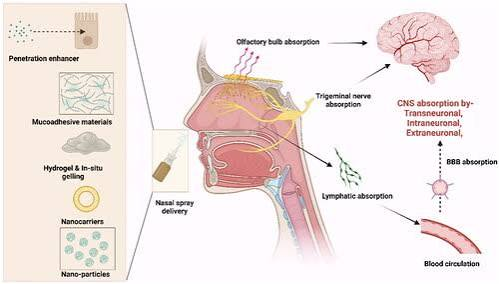

Administration route has always been one of the quieter variables in peptide research — overshadowed by questions about receptor targets, sequence design, and purity, but no less important to the outcome of a study. Over the past several years, intranasal delivery has emerged as a preferred format for a growing number of laboratory protocols, particularly in cognitive and neurological research. Products such as the Adalank nootropic peptide nasal spray reflect this shift, having been formulated specifically to allow researchers to study peptide behavior via the nasal-to-brain pathway rather than through injection or oral routes.
This article explores why intranasal delivery has gained traction in peptide research circles, the physiological logic behind it, and what limitations still shape how the method is used.
The Core Problem Nasal Delivery Is Designed to Address
Peptides face a structural challenge that small-molecule drugs generally don’t: they are fragile. Oral administration exposes a peptide to gastric acid and enzymatic breakdown in the digestive tract, which can degrade the molecule before it ever reaches systemic circulation. Injection routes bypass digestion but introduce other complications for researchers, particularly around access and the practicalities of frequent laboratory administration.
Intranasal delivery offers a middle path that has made it attractive for research settings. The nasal cavity is lined with highly vascularized tissue and sits in close anatomical proximity to the olfactory bulb and trigeminal nerve pathways — structures that provide a comparatively direct route toward the central nervous system. For researchers studying compounds intended to interact with neural pathways, this anatomical shortcut is scientifically useful: it allows a peptide to be introduced in a way that may reach relevant tissue with less systemic degradation than the oral route typically involves.
Why This Matters Specifically for Cognitive and Neurological Research
The blood-brain barrier is one of the most persistent obstacles in neuroscience. Many compounds that show promising receptor-binding characteristics in vitro simply cannot cross the barrier efficiently enough to be useful in a whole-organism model. This has made the search for viable delivery mechanisms just as important as target selection itself.
Intranasal administration is of particular interest to researchers because the olfactory and trigeminal pathways offer a route that, at least in laboratory models, appears to allow more direct engagement with central nervous system tissue compared to systemic absorption followed by an attempt to cross the barrier from the bloodstream. This has made nasal spray formats a common research tool specifically for peptides being studied in connection with cognitive signaling, alertness, and neuroprotective pathways — areas where the ultimate destination of the compound matters as much as its receptor affinity.
Practical Advantages in a Laboratory Setting
Beyond the physiological rationale, intranasal formats offer researchers several practical benefits that have contributed to their growing use:
Consistency of dosing volume — A pre-filled sprayer format allows for standardized, repeatable administration volumes across a study, which reduces one source of variability compared to reconstitution-based protocols.
Reduced preparation burden — Nasal spray peptides typically arrive pre-formulated in liquid form, removing the lyophilized-powder reconstitution step that introduces additional handling variables into a research protocol.
Non-invasive repeat administration — For studies requiring multiple administration points over time, a nasal format avoids the cumulative tissue considerations that come with repeated injections, which can simplify longer observational research designs.
What Nasal Delivery Research Has Not Yet Established
None of this should be read as an endorsement of therapeutic use. Intranasal peptide research remains firmly in the preclinical and mechanistic stage. Most published work in this area is limited to in vitro assays and animal models exploring absorption pathways and receptor engagement; large-scale, peer-reviewed human clinical data on nasal peptide delivery for cognitive purposes remains limited. None of the compounds discussed in this space are approved by the FDA to diagnose, treat, prevent, or cure any condition, and they are not intended for human or animal use outside of a controlled laboratory setting.
The scientific interest in nasal delivery is about mechanism, not application. Researchers are trying to understand how a delivery route affects a peptide’s behavior and reach — not making claims about outcomes for an end user.
Purity and Formulation Still Matter More Than the Delivery Format
A well-designed delivery route can’t compensate for a poorly verified compound. Regardless of administration format, the reliability of a research peptide still comes down to synthesis accuracy and third-party purity verification — typically confirmed through HPLC analysis and documented in a batch-specific Certificate of Analysis. This is especially relevant for nasal spray formats, where consistent formulation matters for reproducible dosing across a study.
This is one of the reasons laboratories increasingly rely on suppliers that specialize specifically in research-grade peptides rather than general wellness retailers. Iron Peptides is one example of a supplier built around this model, offering nasal spray and other peptide formats with documented lab verification for each batch — a standard that has become increasingly important as intranasal research protocols have grown more common.
A Delivery Method Still Under Active Study
Nasal delivery hasn’t solved every challenge in peptide research, but it has opened a genuinely useful line of inquiry into how molecules interact with the central nervous system outside of injection-based models. As formulation science and analytical verification continue to improve, intranasal protocols are likely to remain a growing area of interest — not as a finished answer, but as one of the more promising tools researchers currently have for studying peptide behavior at the point where the body meets the brain.