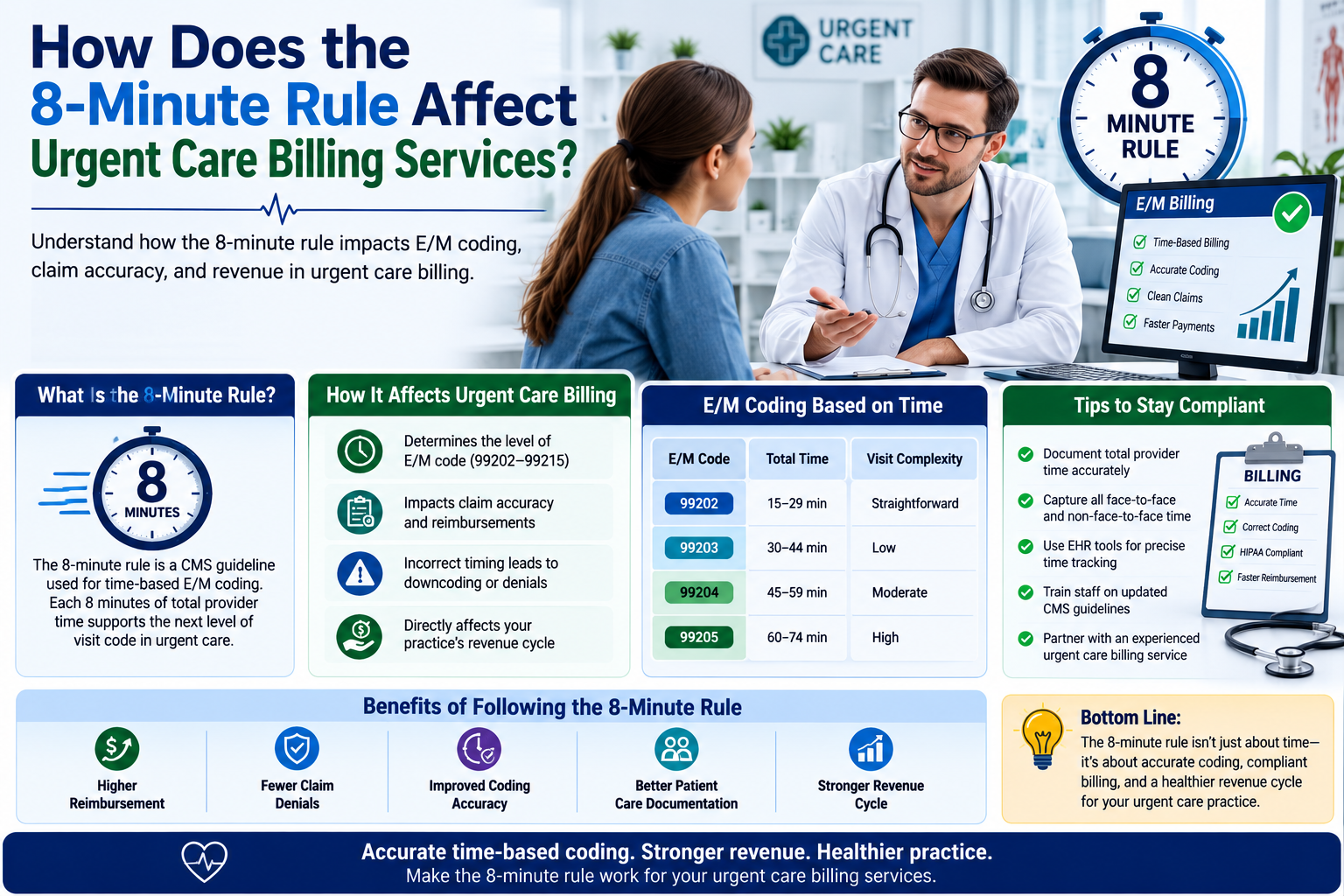

Urgent care clinics often treat patients who need immediate attention for injuries, illnesses, and other non-life-threatening conditions. Because these visits can involve multiple procedures and services, accurate time-based billing is essential for proper reimbursement. This is where the 8 minute rule becomes important in certain outpatient therapy billing situations.
For urgent care providers, understanding how time-based billing rules apply can help reduce coding errors, prevent claim denials, and improve documentation. Professional urgent care billing services can also help practices review time-based services, select appropriate codes, and maintain compliance with payer requirements.
What Is the 8-Minute Rule?
The 8 minute rule is a time-based billing guideline used primarily for certain outpatient therapy services billed under Medicare. It determines how many timed service units can be reported based on the total amount of direct treatment time provided to a patient.
The rule generally applies when services are billed using timed procedure codes. A provider must document the actual time spent delivering eligible services and then calculate the appropriate number of billable units.
It is important to understand that the 8-minute rule does not automatically apply to every urgent care service. Its relevance depends on the type of service performed, the applicable payer policy, and the billing codes used. This distinction is critical because applying the rule incorrectly can lead to inaccurate claims.
Why Does the 8-Minute Rule Matter in Urgent Care Billing?
Urgent care billing may involve different types of services, including evaluation and management, minor procedures, wound care, injections, diagnostic services, and sometimes therapy-related services. When a service is time-based, billing teams must determine whether the 8-minute rule applies.
Accurate application helps ensure that:
- The correct number of service units is reported
- Documentation supports the billed time
- Claims comply with payer-specific requirements
- The risk of overbilling is reduced
- Underbilling is avoided when eligible services are properly documented
Experienced urgent care billing services can help practices identify which services require time-based calculations and which should be billed using other coding rules.
How Is the 8-Minute Rule Calculated?
The 8-minute rule is based on the total amount of direct treatment time for eligible timed services. The calculation generally determines the number of billable units based on the total minutes documented.
For example, if a provider delivers 8 to 22 minutes of an eligible timed service, one unit may generally be reportable under the applicable rule. Additional time may support additional units according to the relevant payer guidelines.
However, billing teams should not rely on a simple calculation alone. The correct method can depend on:
- The payer
- The procedure code
- Whether multiple timed services were performed
- The total treatment time
- The documentation in the medical record
- Medicare or commercial payer requirements
This is why professional billing review is valuable for urgent care practices that provide time-based services.
The Role of Documentation in 8-Minute Rule Compliance
Documentation is one of the most important factors in applying the 8-minute rule correctly. The medical record should clearly support the service provided and the time associated with that service when time is a determining factor for billing.
Useful documentation may include:
- The type of service performed
- The start and end time, when required
- The total direct treatment time
- The provider who delivered the service
- The clinical reason for the service
- The patient’s response or outcome when relevant
Vague documentation can make it difficult to support a claim during a payer review. Strong documentation gives the billing team the information needed to assign the correct units and submit a defensible claim.
How Can the 8-Minute Rule Affect Claim Accuracy?
Incorrect application of the 8-minute rule can create several billing problems. If a practice reports too many units, the claim may be considered inaccurate or non-compliant. If too few units are reported, the practice may lose revenue for services that were appropriately provided.
Common issues include:
- Reporting units without sufficient documented time
- Miscalculating total service minutes
- Applying the rule to services that are not subject to it
- Combining time incorrectly across multiple procedures
- Failing to follow a specific payer’s billing policy
Professional urgent care billing services can help identify these issues before claims are submitted.
Common 8-Minute Rule Mistakes in Urgent Care Billing
Applying the Rule to Every Time-Based Service
One of the most common mistakes is assuming that the 8-minute rule applies to every service involving time. The rule has a specific application, and practices must first determine whether the service and payer fall within its scope.
Using Incomplete Time Documentation
If the medical record does not clearly support the time billed, the claim may face scrutiny. Billing teams need reliable documentation to calculate eligible units correctly.
Ignoring Payer-Specific Requirements
Medicare and commercial insurers may have different billing rules. A method that is appropriate for one payer may not be appropriate for another. This makes payer-specific knowledge an important part of accurate billing.
Reporting Unsupported Units
Billing additional units without adequate documentation can create compliance risks. Every reported unit should be supported by the applicable coding and documentation requirements.
Confusing Timed and Untimed Services
Not every procedure is billed according to the number of minutes provided. Confusing timed services with untimed services can result in incorrect code selection and inaccurate claims.
How Urgent Care Billing Services Help With 8-Minute Rule Compliance
Outsourced urgent care billing services can support clinics by managing the technical aspects of coding, documentation review, claim submission, and follow-up.
A professional billing team may help with:
Reviewing Time-Based Documentation
Billing specialists can review records to determine whether the documented service time supports the units reported.
Applying Payer-Specific Guidelines
Experienced billers can help identify differences between Medicare requirements and commercial payer policies, reducing the risk of using a one-size-fits-all billing approach.
Identifying Coding Errors
A billing review may identify incorrect units, missing documentation, mismatched codes, or other issues before a claim is submitted.
Supporting Clean Claims
Accurate coding and complete documentation can help reduce avoidable claim errors and improve the overall efficiency of the revenue cycle.
Monitoring Denials
If claims are denied because of time-based billing issues, the billing team can investigate the reason, correct the underlying problem when appropriate, and manage the appeal process according to payer requirements.
How Does the 8-Minute Rule Affect Urgent Care Revenue Cycle Management?
The 8-minute rule can affect several parts of the revenue cycle. Incorrect unit calculation may lead to claim rework, payment delays, or lost reimbursement. Repeated billing errors can also increase administrative workload for the clinic.
A structured billing process helps ensure that:
- Services are coded correctly
- Documentation supports billed services
- Claims are reviewed before submission
- Denials are tracked and analyzed
- Billing patterns are monitored over time
By incorporating appropriate time-based billing reviews into the revenue cycle, urgent care practices can improve billing accuracy and reduce unnecessary administrative challenges.
Best Practices for Managing the 8-Minute Rule
Urgent care practices can take several steps to improve compliance and billing accuracy.
Create Clear Documentation Procedures
Providers and clinical staff should understand what information needs to be documented when time affects billing.
Train Staff Regularly
Coding and payer requirements can change. Regular training helps billing and clinical teams maintain consistent processes.
Use Pre-Submission Claim Reviews
Reviewing claims before submission can help identify missing time documentation or incorrect units.
Maintain Payer-Specific Billing Guidelines
Keeping current payer rules organized helps billing teams apply the correct requirements to each claim.
Conduct Periodic Audits
Internal audits can identify recurring errors and provide opportunities for process improvement.
The Importance of Expert Billing Support
The 8 minute rule can be complex when multiple services, payer policies, and documentation requirements are involved. Urgent care providers should avoid assuming that every time-based service follows the same billing calculation.
A knowledgeable urgent care billing services provider can help practices review applicable services, improve documentation processes, support accurate coding, and manage claims more efficiently. The goal is not simply to report more units but to ensure that every billed service is accurately supported by the medical record and applicable payer rules.
Frequently Asked Questions
Does the 8-minute rule apply to all urgent care services?
No. The 8-minute rule does not automatically apply to every urgent care service. Its application depends on the type of service, procedure code, payer requirements, and applicable billing guidelines.
Why is documentation important for the 8-minute rule?
Documentation supports the time and services reported on the claim. Without sufficient documentation, the billed units may not be adequately supported.
Can urgent care billing services help with 8-minute rule compliance?
Yes. Professional billing teams can help review documentation, apply appropriate payer guidelines, identify coding issues, and support accurate claim submission.
What happens if the 8-minute rule is applied incorrectly?
Incorrect application may result in claim denials, payment delays, inaccurate reimbursement, claim rework, and potential compliance concerns.
How can urgent care practices reduce 8-minute rule errors?
Practices can reduce errors through accurate documentation, staff training, payer-specific guideline reviews, pre-submission claim audits, and support from experienced billing professionals.
Conclusion
The 8-minute rule can influence billing accuracy when an urgent care practice provides services that fall under applicable time-based billing requirements. Although the rule does not apply to every urgent care service, understanding when and how it applies is essential for accurate coding and compliant reimbursement.
By combining strong documentation, payer-specific knowledge, regular audits, and reliable urgent care billing services, practices can reduce avoidable billing errors and create a more efficient revenue cycle. The most effective approach is to evaluate each service according to the applicable coding and payer requirements rather than applying the 8-minute rule universally.